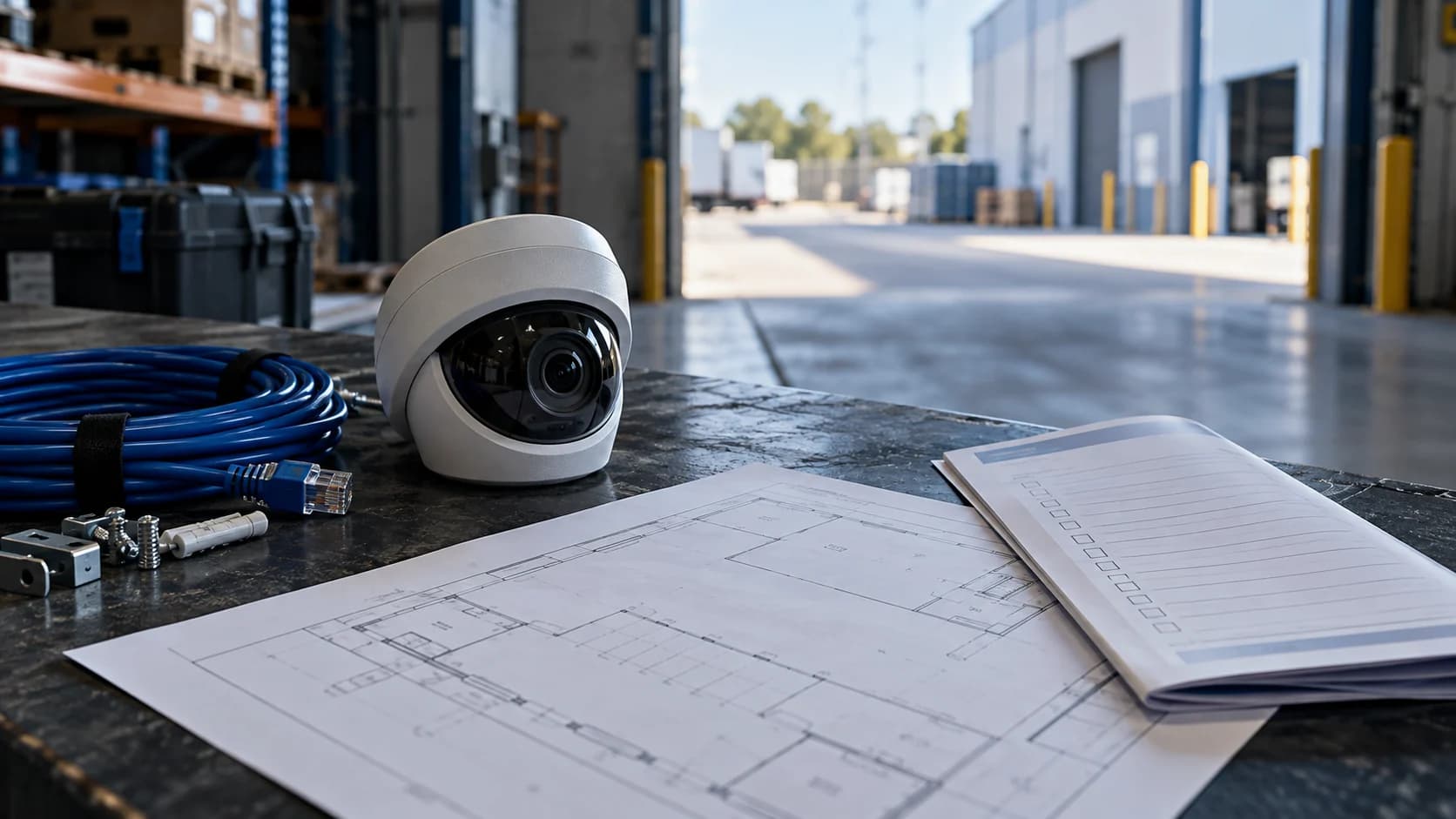
A quiet pilot can leave the biggest questions unanswered. Design exercises that reveal whether the proposed service will recognize the site’s ordinary exceptions and hand off the awkward ones.
The idea in view · Planning diagram
A pilot should end in a decision
- Choose requirement
- Select difficult view
- Stage safe scenario
- Record actual result
- Retest correction
- Accept or limit duty
Choose representative conditions
Select a difficult gate, a routine access route and a view with realistic night conditions. Include operational activity such as cleaning or deliveries. Explain why these views represent the intended rollout and which site types remain untested.
Use safe staged scenarios
Coordinate authorized walk tests with the site manager and provider. Mark them as exercises and keep emergency dispatch out of scope. Record the scene, expected event, review result and handoff. Include video loss and an unanswered test contact through approved simulation.
Decide from recorded exceptions
Classify failures by camera view, rule, connection or workflow. Retest the corrected scenario before sign-off. Expand only to locations with comparable conditions; a pilot in one country does not establish language or response capability elsewhere.
Write the decision before running the exercise
Choose the person who will approve expansion and ask what they would need to see. For a depot, that could be a reviewed gate event after dark, a legitimate late delivery handled correctly and a missing feed reported to the right owner. Decide which failure stops activation. This prevents the team from moving the goalposts because the pilot has reached its scheduled end.
Keep the result specific. A successful walk through one gate supports that route under those conditions. It says much less about a crowded loading bay, another recorder family or a different country. Group unresolved questions and choose the next representative test. Expanding deliberately is more useful than accumulating sites that all inherit an untested assumption.
Start with the decision the pilot must support
A pilot should end with an acceptance decision, a list of unresolved conditions or a reason to stop. State that decision before choosing the cameras. If the question is whether existing equipment can support after-hours review, a demonstration on a new test camera elsewhere does not settle it. If the question concerns handoffs, a clean video stream alone is insufficient evidence. Select the parts of the actual service that the business is deciding whether to rely on.
Keep the sample representative and manageable. Include a difficult view, a normal route and a relevant operating exception rather than selecting only the easiest camera. Record why those views were chosen and what they do not represent. A pilot at one warehouse does not establish compatibility for every recorder, country or connectivity arrangement in a portfolio. Use its results to define the next test, not to erase the remaining differences.
Build safe staged scenarios
Use authorized activity in agreed locations and notify the people who might otherwise interpret the exercise as a real incident. Define the route, time, expected event and intended response record. Do not test by encouraging unsafe entry, trespass or an unannounced emergency call. Separate technical exercises from real response activity so the test does not create an avoidable operational problem.
Include negative cases. Expected activity should be recognized in context, while a staged exception should follow the agreed review path. Test what happens when a contact does not answer, a view is unavailable or the video is insufficient to decide. Those outcomes are useful evidence when recorded honestly. A failure can identify a necessary change before wider rollout; suppressing it to make the pilot look successful defeats the purpose.
Reference context: Axis: Object Analytics manual
What to retain after each test
Record the scenario identifier, configuration version, date, lighting, relevant camera aliases and observed result. Separate the event time from system receipt, human decision and contact attempt. Keep the evidence in the approved system and place only references in the general pilot log. An outcome such as “worked” is hard to assess later; specify which expected steps occurred and which were not observed.
After a change, identify which earlier tests need to be repeated. Narrowing an event region may reduce nuisance alerts while changing coverage of a real route. A successful retest should use the relevant difficult condition, not simply confirm that the interface saved a setting. Decide who may accept residual gaps and how those gaps are communicated to the people operating the site. Unresolved issues should carry into the rollout plan with named owners.
A fictional pilot that produces a conditional decision
Imagine a pilot covers a front gate, a loading lane and a rear approach. The gate tests succeed in daylight and darkness. The loading lane is usable except when a trailer is parked in its normal waiting position. The rear approach produces video but not the expected event on one route. The appropriate decision might be to accept the gate, redesign or supplement the loading-lane view and keep the rear approach outside accepted monitoring until the missed route is understood.
That is a useful result even if it delays rollout. It shows which evidence supports the accepted task and which work remains. The team should record the condition that would close each gap, who owns the action and which test will be repeated. A calendar end date should not automatically convert a conditional pilot into a fully accepted service. The commercial scope should reflect the decision actually reached.
Make the call
What should the pilot prove?
| Situation | Decision to make | What to ask for |
|---|---|---|
| There were no real incidents | Whether agreed scenarios can be handled | Authorized staged tests, not a success claim |
| One camera model worked | Whether another hardware family behaves the same | A representative model and firmware test |
| A test contact answered | Whether the backup path also works | A planned no-answer exercise |
Before you move on
- Name a pilot owner and decision date.
- Write scenarios with expected results and safe test controls.
- Review failures and retests before approving expansion.
A worksheet you can actually use
Start with the blank sheet. Add one row per item, assign an owner and mark anything unresolved as pending. The completed example shows the level of detail to aim for.
Keep completed security plans private. Use aliases; keep passwords, access codes, personal contacts and footage links in your approved systems.
How to fill the worksheet
- Scenario
- Describe an authorized test that answers one acceptance question. Avoid vague entries such as test all cameras.
- View
- Identify the relevant view alias and configuration reference so the result can be connected to the actual tested system.
- Condition
- Record lighting, normal obstructions and activity conditions. A result from an empty daylight scene may not represent overnight work.
- Expected action
- Define which observable steps should occur, from useful video through any required event delivery and accepted handoff.
- Observed result
- Write what actually happened, including partial success, missing evidence and uncertainty rather than automatically recording a pass.
- Retest owner
- Name who owns the correction and which relevant scenario must be repeated before the affected duty is accepted.
A worked example
Fictional pilot: a depot tests its gate in daylight and darkness, then discovers stock blocking the side approach. The team moves the stock and repeats that scenario rather than averaging it away.
| Scenario | View | Condition | Expected action | Observed result | Retest owner |
|---|---|---|---|---|---|
| Authorized walk | Y01 | After dark | Review and test contact only | To complete | Pilot lead |
Questions readers bring to this task
What else should you know?
When should a pilot be extended?
When an important condition has not occurred or a correction has not been retested. Set a specific next test and decision date rather than extending indefinitely. If a condition cannot be tested safely, document that limit and obtain a separate acceptance decision.
Link to this answer ↗How long should a monitoring pilot run?
Long enough to test the relevant operating and lighting conditions, complete the agreed scenarios and investigate material failures. A fixed number of quiet days is not evidence of detection or response performance. Choose duration from the work to be observed and any conditions that cannot yet be reproduced.
Link to this answer ↗Does a pilot need real incidents?
No. Safely staged and authorized scenarios can test defined parts of the service without waiting for an incident. Label them as tests and retain the actual observations. A staged exercise does not establish a future incident-prevention rate or justify a fictional customer outcome.
Link to this answer ↗Can one site prove a multi-site rollout is ready?
It can establish evidence for the tested configuration and process. Other sites may have different equipment, layouts, lighting, networks and local response needs. Group sites by meaningful differences, test representative configurations and keep site-specific acceptance decisions before wider reliance.
Link to this answer ↗Notes & sources
A staged exercise is not a measured detection benchmark or a guarantee of real incident outcomes.
Reviewed October 27, 2026. The examples and worksheets are planning aids, not customer results or a statement of contracted service.
- ProtectUK: CCTV operational checklist (2022)
Operational prompts on purpose, coverage, lighting and review. Its historical legal references are not used as current law.
- Surveillance Camera Commissioner: Buyers Toolkit (2018)
Historical operational requirements, commissioning and handover context; not current legal advice or certification.
- Axis: Object Analytics manual
Manufacturer guidance on scenes, filters and detection limitations. Not evidence of NightMarshal detection performance.