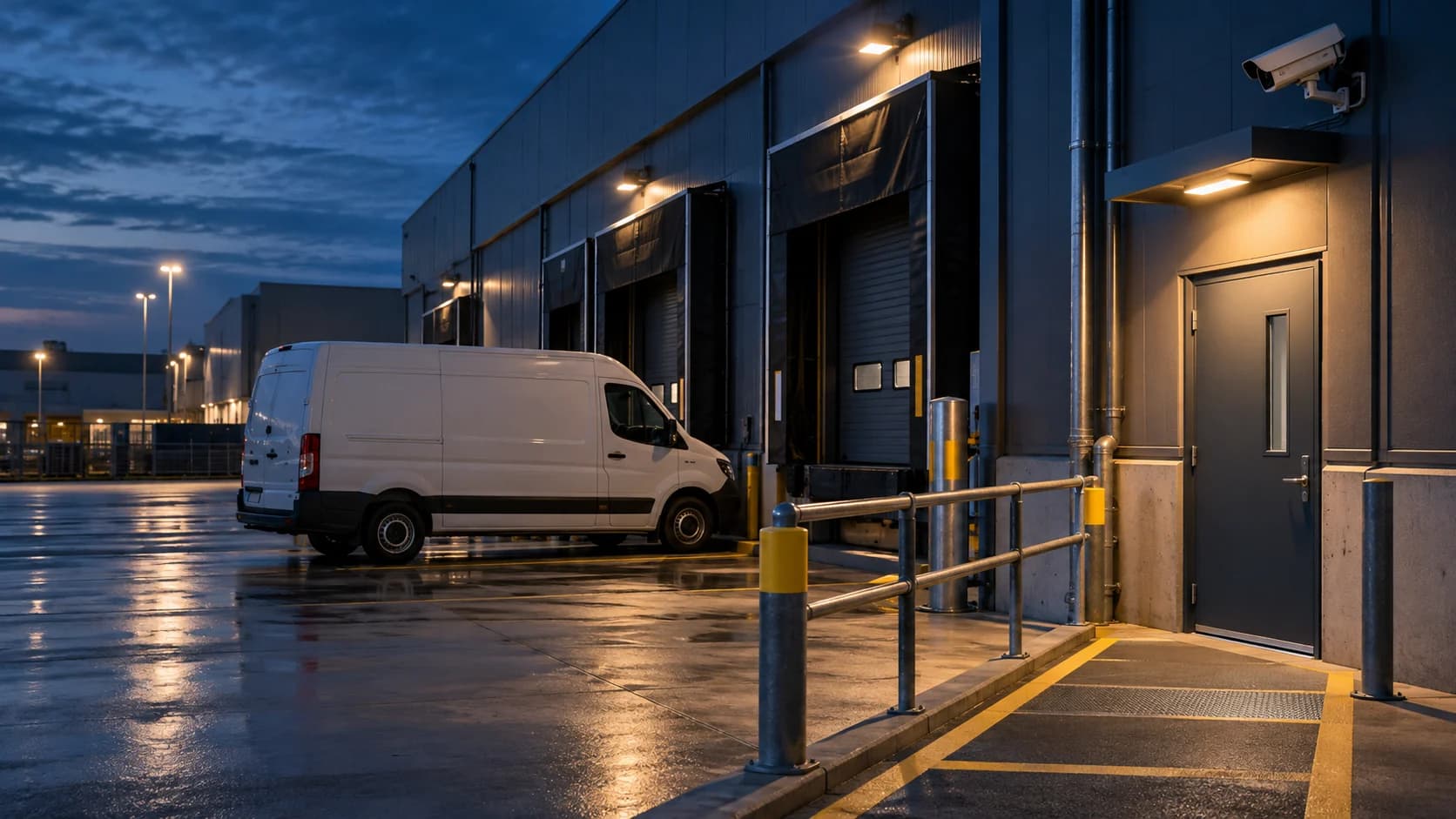
A loading yard contains several different questions at once: which arrival is expected, which route is restricted and which part of the scene is hidden by today’s trailers.
The idea in view · Planning diagram
Plan for the yard that actually operates
- Arrival lane
- Waiting trailers
- Pedestrian approach
- Service door
- Restricted cage
- Normal obstruction
Map routes and conflicts
Identify pedestrian paths, vehicle entrances, loading positions and restricted storage. Check how parked trailers change visibility. Treat traffic safety controls as a separate responsibility; a camera review service should not be assumed to prevent collisions.
Match rules to operations
Define schedules and temporary delivery permissions by area. Specify which uncertain arrivals go to the duty manager and which actions reviewers may take. Do not treat a recognizable vehicle shape as proof that a driver is authorized.
Validate the difficult conditions
Test the gate approach under headlights and when bays are occupied. Review the record available to the operator, including timing and camera aliases. Adjust the scope when the view cannot support the required task.
Design around loaded conditions
Walk the relevant paths when bays are occupied as well as when the yard is empty. Check open gates, high vehicles, headlights and the narrow routes between parked equipment. A camera map drawn on an empty day can exaggerate useful visibility. Record the route and decision each view supports instead of relying on one general yard label.
Keep logistics, site security and traffic safety responsibilities clear. A monitoring reviewer may need to verify a closed-area event, while the site’s own traffic plan governs vehicle and pedestrian safety. Do not imply that a camera review service prevents collisions or authorizes a driver’s movement. Give uncertain deliveries an available site decision role.
Divide the yard into operational questions
A loading yard can contain expected arrivals, waiting vehicles, pedestrian routes, restricted equipment areas and service doors. One broad instruction to monitor the yard leaves the reviewer guessing which activity matters. Identify each task and the view that can support it, with the accepted hours and relevant normal activity.
Use the site's own traffic and safety arrangements as constraints. Monitoring instructions should align with approved routes, not create new directions for moving vehicles or people. The business needs to decide which role can confirm a booking, authorize an exception or arrange local action. A camera view is useful context, but it does not grant the reviewer authority to control every part of the operation.
Test the view with normal obstructions present
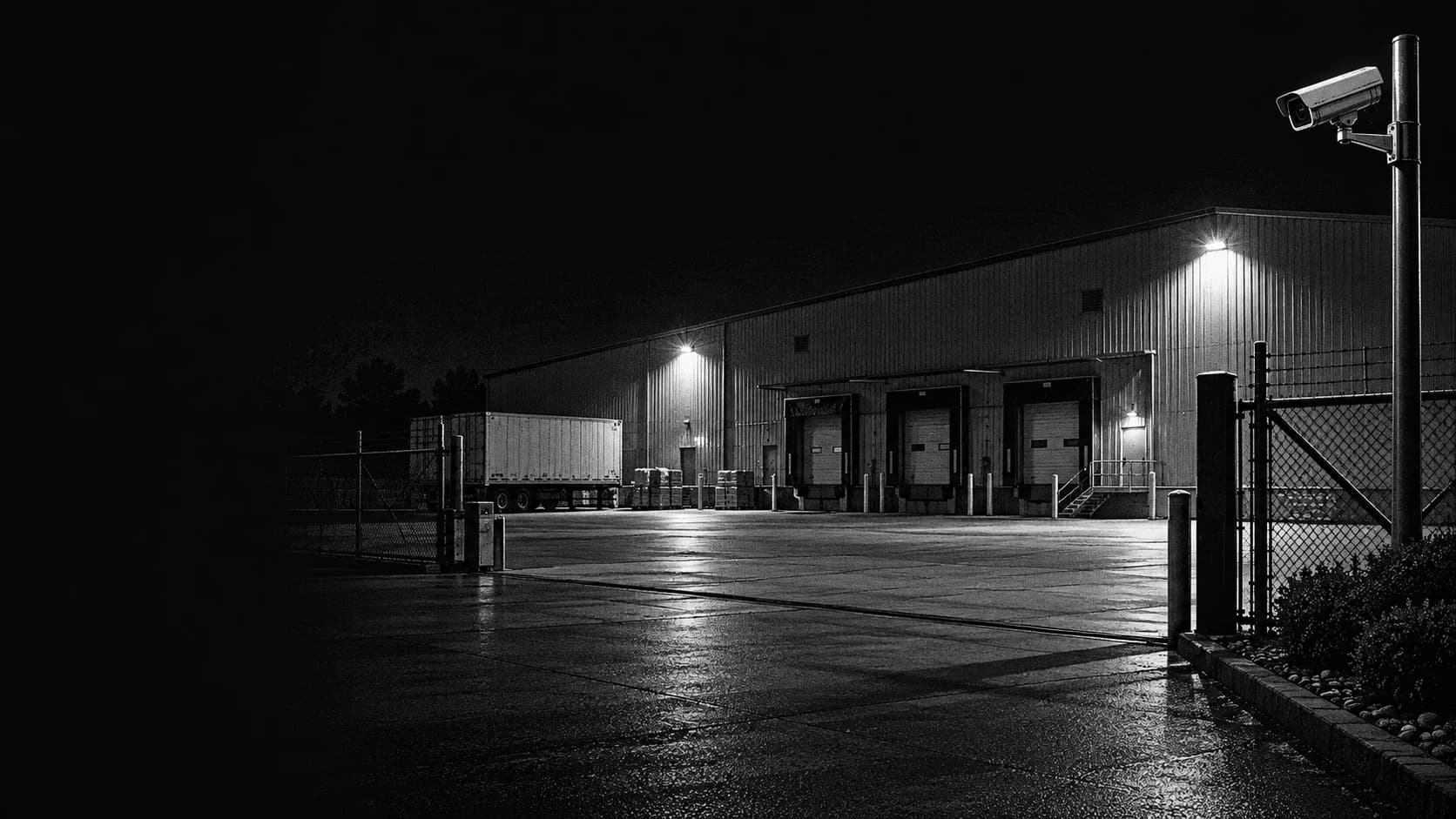
Trailers, stacked goods and parked vehicles can change the scene throughout the day. A wide empty-yard image can overstate coverage during actual loading. Test the relevant approach with the ordinary waiting positions and lighting. Record permanent and temporary obstructions separately and identify the operating consequence.
Check moving detail and event behavior where applicable. A person may be visible near a door but disappear behind a vehicle before the relevant boundary. A detection region may no longer match the current route after a layout change. Use authorized safe scenarios and vendor-specific guidance. Do not infer accepted coverage simply from the number of cameras or a plan showing overlapping viewing cones.
Connect arrivals, exceptions and response
Keep expected delivery information current through a controlled process. A recognizable vehicle arriving outside the approved window still needs the accepted clarification path. A legitimate delivery using a restricted route may also need a decision. The instruction should explain who can confirm the fact and what happens when no one answers.
Record camera faults and yard-layout changes alongside operating exceptions. If a vehicle blocks an important view, the site may need a temporary arrangement or a different design. Do not ask the reviewer to compensate for missing visibility with a confident narrative. Keep the accepted duty clear and assign the physical or technical correction to the party that can actually implement it.
A fictional yard review during a busy delivery period
A business tests a loading lane while the yard is empty and sees every door clearly. During a normal busy period, two trailers occupy the waiting area and hide the pedestrian approach to an equipment cage. The original demonstration did not represent the conditions that matter to the duty.
The team maps the routes with normal parking, reviews lighting and identifies which camera can provide useful context. It may change an accepted waiting position, assess another view or document a remaining gap. The delivery instruction and escalation plan are updated accordingly. A successful retest supports the defined configuration; it does not establish that every future layout or incident will be visible. The plan needs an owner who notices when the yard changes again.
Make the call
Which movement needs a different rule?
| Situation | Decision to make | What to ask for |
|---|---|---|
| An expected delivery uses the dock | Whether it fits the approved operating window | Booking context and normal procedure |
| A person enters a restricted storage area | Whether a separate review duty applies | An area-specific event and decision path |
| A parked trailer blocks the approach | Whether the accepted view remains useful | A layout correction or alternate accepted view |
Before you move on
- Map entrances, restricted zones and changing obstructions.
- Write area-specific schedules and exception handling.
- Test busy and closed-yard conditions with permission.
A worksheet you can actually use
Start with the blank sheet. Add one row per item, assign an owner and mark anything unresolved as pending. The completed example shows the level of detail to aim for.
Keep completed security plans private. Use aliases; keep passwords, access codes, personal contacts and footage links in your approved systems.
How to fill the worksheet
- Area
- Divide the yard into meaningful routes and work areas rather than describing the whole property as a single camera task.
- Normal activity
- Record the approved arrival, waiting or loading behavior with the current confirmation source where authorization matters.
- Restricted condition
- State the observable route or condition that needs clarification, without treating every unusual movement as proof of intent.
- Review action
- Describe the accepted review and escalation action, keeping traffic direction or physical intervention outside ungranted authority.
- View limitation
- Record normal trailer, storage and lighting limits and their consequence, with any material change assigned for review.
A worked example
Fictional yard: the delivery lane remains active until 22:00, while the equipment cage is restricted throughout the evening. The team keeps those rules separate.
| Area | Normal activity | Restricted condition | Review action | View limitation |
|---|---|---|---|---|
| Equipment cage | Authorized staff only | Unverified entry | Contact duty manager | Trailer may obstruct |
Questions readers bring to this task
What else should you know?
What should we test first?
Choose the required route with the most realistic visibility challenge, such as a gate approach behind parked trailers. Test the received video and event under authorized conditions, then check how an uncertain arrival reaches the duty manager. Keep unresolved obstructions outside the accepted claim.
Link to this answer ↗How many cameras does a loading yard need?
The count depends on tasks, layout, useful detail, lighting and obstructions. Begin with the routes and decisions the business needs supported, then assess views. A universal camera-per-area ratio would hide the operational differences that determine whether the duty can work.
Link to this answer ↗Can a wide-angle camera cover the whole yard?
It may show a broad scene while lacking useful detail on a distant route or losing it behind vehicles. Test the actual task under normal conditions. Visible area and accepted monitoring capability are different questions.
Link to this answer ↗What should change when trailer parking changes?
Review affected sightlines, event regions, delivery instructions and any accepted coverage dependency. If a material route is newly obscured, communicate the gap and assign the correction. A camera remaining online does not mean the previous yard plan is still accurate.
Link to this answer ↗Notes & sources
This is a security planning aid, not a traffic management or workplace safety system design.
Reviewed October 27, 2026. The examples and worksheets are planning aids, not customer results or a statement of contracted service.
- ProtectUK: CCTV operational checklist (2022)
Operational prompts on purpose, coverage, lighting and review. Its historical legal references are not used as current law.
- GOV.UK: police requirements for CCTV systems
Purpose, quality, storage, export and playback considerations; not a promise of police response.